

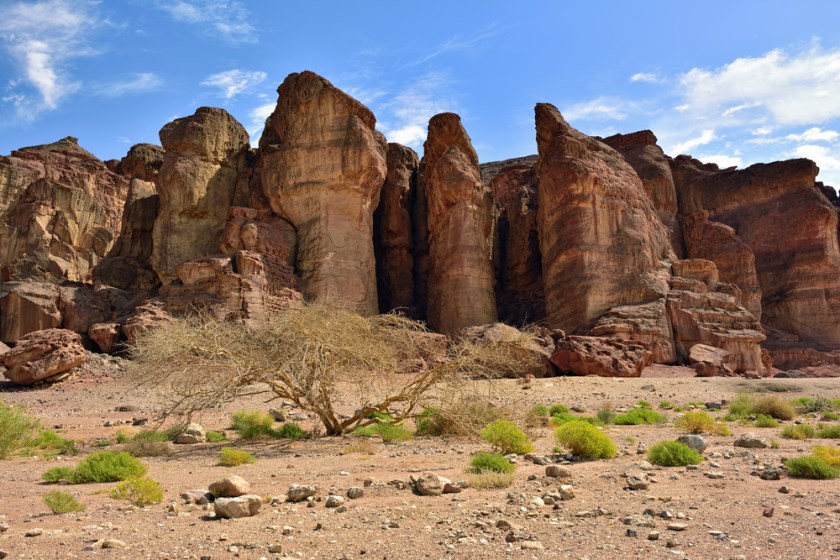
The book: King Solomon’s Mines is a novel from the 19th century written by H. Rider Haggard. The book was inspired by the discovery of ancient copper mines in the south of the Aravah in “Timna”, close to the Red Sea.
The Bible does not mention the mines that Solomon had dug. So, referring those ancient mines to King Solomon came from three places in the Bible:
a land in which you will eat bread without scarcity, in which you will lack nothing; a land whose stones are iron and out of whose hills you can dig copper. (Deuteronomy 8:9)
From this verse in Deuteronomy, we learn that there were iron and copper mines in Canaan before the sons of Israel conquered it.
… King Solomon also built a fleet of ships at Ezion Geber, which is near Elath on the shore of the Red Sea, in the land of Edom (1 Kings 9:26)
The verse above tells that Solomon had ships in the Red Sea. So the copper mines near the Red Sea could have been one of the resources of the wealth of Israel in his time.
… All these articles which Huram made for King Solomon for the house of the Lord were of burnished bronze. 46 In the plain of Jordan the king had them cast in clay molds, between Succoth and Zaretan. 47 And Solomon did not weigh all the articles, because there were so many; the weight of the bronze was not determined. (1 Kings 7:45-47)
From the verses above, we learn that a great amount of bronze was cast in Israel in the Jordan Valley. Bronze is an alloy of copper and tin.
When ancient mines were found in Timna, they were immediately referred to King Solomon. Nelson Glueck, the first archaeologist to excavate Timna, attributed the site to King Solomon and named it “King Solomon’s mines”.

Archeological finding refute the relation to Solomon
For thirty years, it was widely accepted that those copper mines were built by King Solomon, until the year 1969.
That year, the Israeli archaeologist Benno Rothenberg found an Egyptian temple in Timna, which was dated to 200-300 years before the time of Solomon.
More research and excavations revealed the techniques that were used at the site, and more Egyptian references.
When you visit the site today, you can learn all about copper mining in ancient times and about the Egyptian dominance in this area.
It was well agreed among all scholars that the site was abandoned before the time of David and Solomon and therefore cannot be referred to them.
For the last 50 years, there has been a movement of archaeologists who have tried to refute the historical validity of what is written in the Bible.
It is such a strong approach in the academy that almost every site that was identified with a Biblical story only 70 years ago is now considered incorrect.
Yigael Yadin, the famous Israeli archaeologist who was also the Chief of Staff of the IDF, excavated many sites in Israel and found evidence to support the correctness of the Bible. From the late 60’s of the last century, the fashion changed, and all his findings were being refuted one after another.
Recent findings change the picture again

In 2009, another archeological expedition arrived at Timna led by Dr. Erez Ben-Yosef from Tel Aviv University. This group wanted to date the site and find out who the people working in it were.
In 2012, they concluded their work with new evidence that changed everything that was known before. See the article in: A New Chronological Framework for Iron Age Copper Production at Timna (Israel)
They were able to find organic material that they could date using the radiocarbon dating method. The organic samples include small pieces of cloth, ropes, and other textiles, various types of uncharred seeds (olive pits, grape and date seeds, pistachio, and more), and wood, including small twigs of acacia trees.
The extreme dry and hot climate of Timna helped preserving this organic materials for thousands of years. Just like the case of the Dead Sea Scrolls.
The examination led to the conclusion that most of the mining done in Timna took place after the Egyptians already left the place and is dated to the 10th century B.C.
Dr. Ben-Yosef also suggests that local Edomite tribes were living in the area and developed the skill of mining.
This brings us the new theory about the place: In the time of King Solomon (10th century B.C.) The Edomites were mining copper in Timna. The Israelites under King Solomon could be in political control over this place, just as written in the Bible.
 Ran Silberman